
Quality Evaluation — Subjective? No! But Perception Is.
How professionals separate fact from preference.

A Clearer Way to Evaluate Spirits
Quality is one of the most used — and most misused — words in the world of spirits. It’s easy to say a whisky is “high quality” or a gin is “superior,” but what does that really mean? For professionals, quality isn’t about price, reputation, or personal taste. It’s about what the liquid delivers, judged against clear, objective criteria.
No method of quality assessment is perfect. Experts may disagree, and there will always be nuance. But law, science, and logic provide a solid foundation for judging what’s in the glass. And it takes study, practice, and skill to do this well.
Price — Why We Don’t Use It to Evaluate Quality
Price is often the first thing people look at when they try to guess a spirit’s quality. However, price doesn’t tell the full story. In fact, it’s deliberately left out of many (not all) formal quality assessment — not because it’s unimportant, but because it doesn’t always reflect what’s in the glass.
Price is shaped by countless variables:
Market dynamics (what people are willing to pay in a given country or region)
Individual Earnings
Marketing strategies and brand positioning
Bottle design, packaging, and weight
Production costs (raw material, time, labour, equipment etc..)
Taxes, import duties, and distribution costs
A whisky that seems cheap in the U.S. might be expensive in Thailand. A rum priced high in Europe might be mid-range in its country of origin. These differences have nothing to do with the liquid’s true quality.
That’s why professional assessment focuses on the spirit itself, not its price tag. Price may influence expectations, but it is not a measure of how well the spirit was made, it is a completely different discussion.

Law, Science, Logic — How They Guide Quality
Assessing quality begins with understanding what the spirit claims to be. Before we can judge how well it delivers, we must know the standards it is meant to meet.
The law defines the category — what a spirit should be by production and style, this sets broad expectations on what you’re about to experience.
This means the law sets the minimum standards and core identity of the spirit. It dictates not just the name on the label, but how the spirit must be made, what raw materials are allowed, what processes are required, and often how it must be matured.Science explains the transformations that take place during production — the chemical and physical processes that create the aromas, flavours, and structure we expect.
Logic connects these facts to the glass — if we know the law and understand the science, we can reason what should or should not be present in the final spirit.
These are not abstract ideas — they are practical tools that help us judge what is in front of us. The law sets the boundaries. Production creates certain expected chemical markers. And logic guides us to assess whether the liquid lives up to its name and method.
Take, for example, a Straight Bourbon. By law, it must be aged in new, charred American oak barrels for at least two years. Science tells us that charring breaks down lignin in the oak, forming vanillin — the chemical behind vanilla aroma. We know that extraction from the oak contributes not only vanilla, but caramel and spice notes, along with colour and texture. Logic tells us: if we’re tasting Straight Bourbon, these characteristics should be present in balance. If there’s no clear oak influence, if the vanilla is absent, or if the alcohol feels raw and disconnected, we must question the spirit’s expressiveness and integration.
Or consider London Dry Gin, defined by EU law as a spirit that must taste predominantly of juniper. Science explains that juniper’s alpha-pinene gives a pine-like character, and that other terpenes contribute citrusy and herbal notes. A gin that fails to deliver a clear, defined juniper note — that buries its identity under excessive spice or citrus — falls short in expressiveness, no matter how well made it seems on the surface. Logic tells us that precision matters: the botanicals should work in harmony, but the gin’s lawful identity must shine through.
In both cases, law, production, and chemistry are not checkboxes — they shape what we should logically expect in the glass. A professional judge does not invent standards; they apply the ones that law, science, and production practice provide.

Is Quality Subjective?
Many people assume that quality is simply a matter of personal taste, that if you like a spirit, it must be good. But this confuses two very different things: perception vs objective quality assessment.
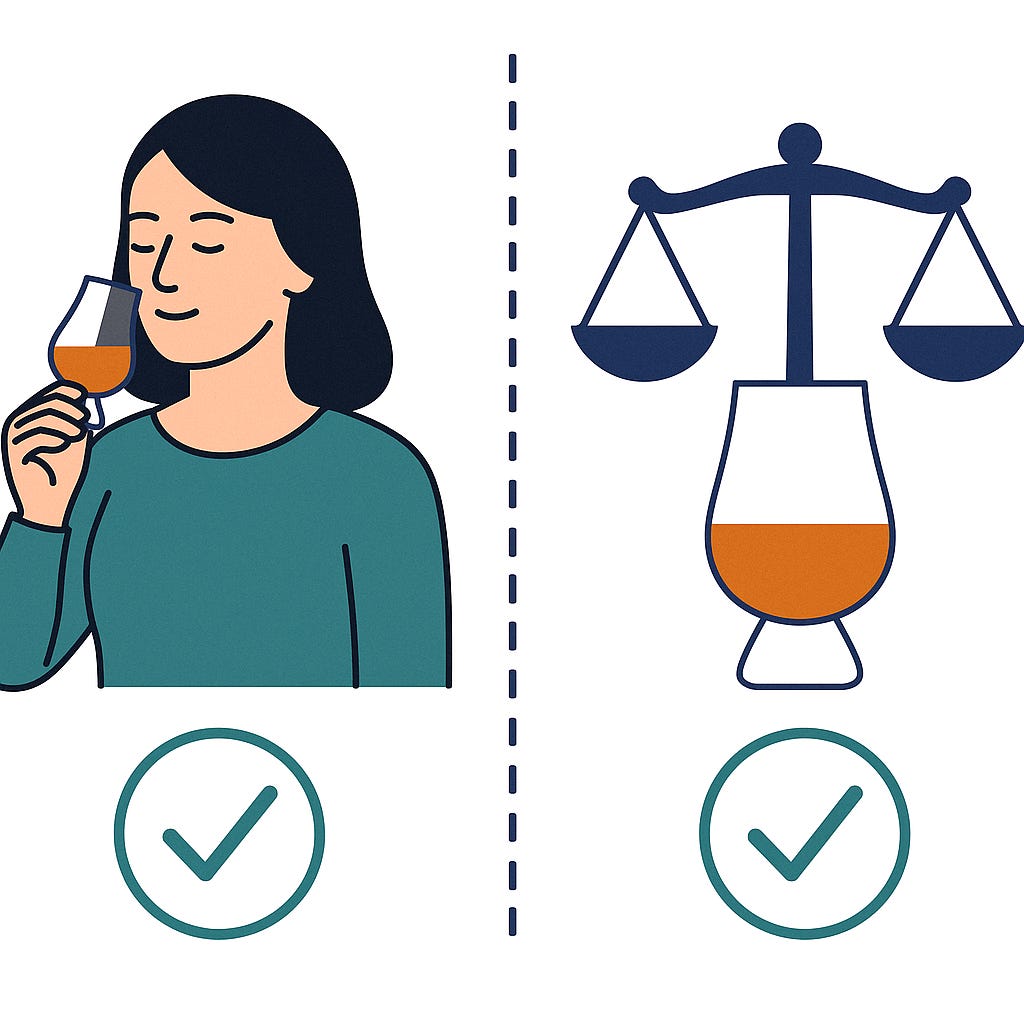
Perception is what you, personally, experience in the glass: whether you like smoky whisky, fruity brandy, or crisp gin. That’s subjective.
Quality Assessment is the trained, reasoned, applied-logic of the spirit’s objective characteristics: balance, precision, structure, and expressiveness. That’s not a matter of personal preference.
✅ Liking a spirit is personal.
✅ Assessing its quality is professional.
Quality can and should be measured using clear criteria that go beyond individual preference. A professional taster puts aside their own likes and dislikes and focuses on what the liquid delivers in terms of its style, structure, and clarity. This is why trained assessors can recognise quality in a spirit they would never choose to drink for pleasure — because they are judging the execution, not their own reaction.
Quality assessment is built on skill, knowledge, and practice. It requires understanding the production laws, techniques, and expected character of a spirit. A smoky whisky might not appeal to everyone, but a trained judge can recognise whether it shows balance, integration, and precision — or whether the smoke overwhelms the structure. The same applies to any style, from light vodka to rich rum. In professional tasting, personal preference is set aside; what matters is how well the spirit achieves what it sets out to be.
Precision and Definition
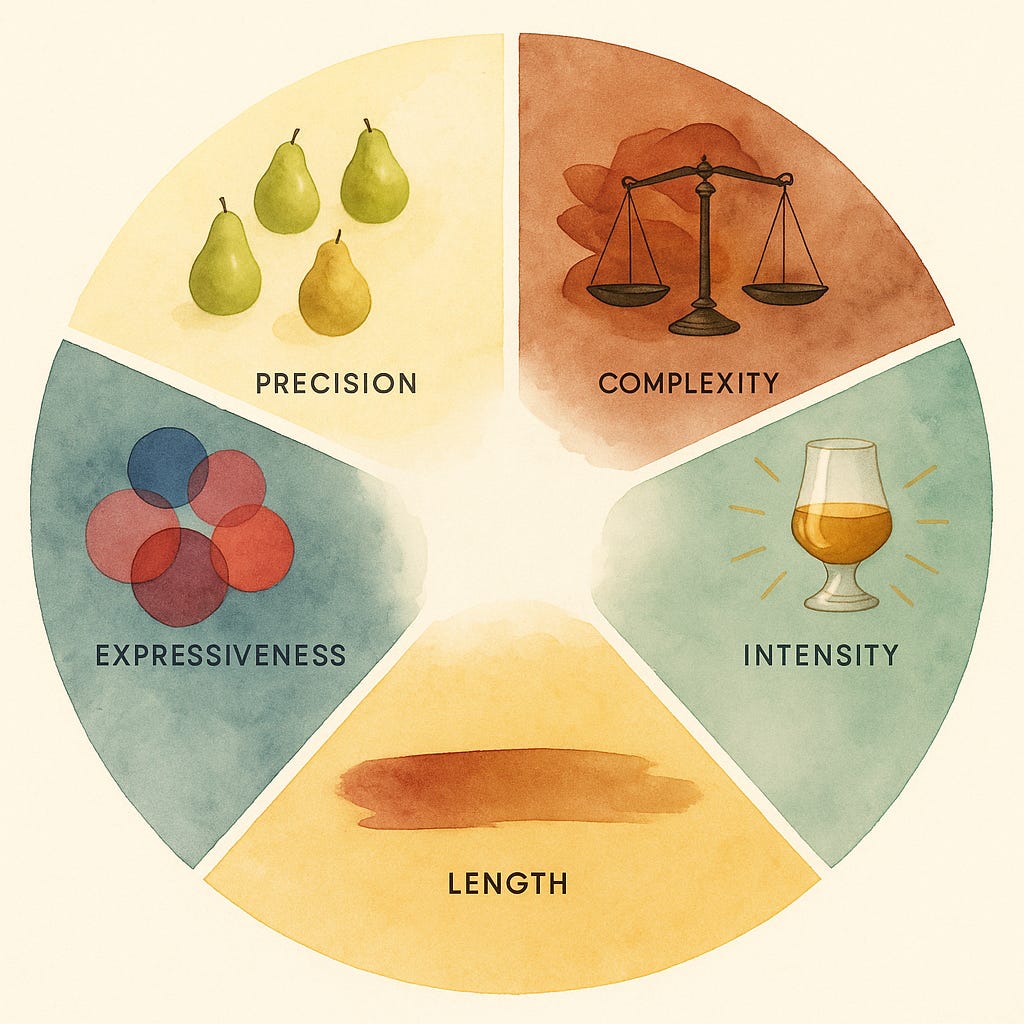
Aroma precision is about clarity. A quality spirit lets you identify its aromas distinctly — not as vague impressions, but as recognisable elements.
You should be able to say “pear,” “clove,” or “vanilla,” not just “fruity” or “spicy.”
This precision comes from great raw materials, high level managed fermentation, careful distillation, and thoughtful maturation.
Precise aromas connect the drinker to the production. They tell you how the spirit was made — what choices shaped it. When aromas are muddled or blurry, they suggest flaws, shortcuts, or imprecision at some point in production.
A professional taster values aroma precision because it reflects both technical skill and integrity in production. The clearer the aromas, the stronger the connection between the liquid and its origins.
Complexity
Complexity means the spirit offers layers — a journey of aromas and flavours that unfold over time. A great spirit reveals different facets as you explore it.
Complexity brings depth. It invites reflection and keeps the drinker engaged. But complexity doesn’t mean louder flavours or stronger aromas. A delicate gin can be complex; a bold rum can be simple. What matters is the layering, not the volume.
And more complexity is not always better. While most spirit categories — except vodka, certain eaux-de-vie, and some liqueurs should show some layering, piling on elements for the sake of it doesn’t increase quality.
Balance
Balance means that no single element dominates or feels out of place. Alcohol, aroma, texture, and flavours should work together in harmony, creating a sense of completeness. Each component supports the others rather than competing for attention.
A balanced whisky might combine grain character, fermentation aromas, oak influence, and alcohol strength so that no single note overwhelms the palate.
Balance doesn’t mean all parts are equal in intensity — it means they are in proportion relative to the spirit’s style. What’s balanced in a high-ester rum or smoky whisky will be very different from what’s balanced in a clean vodka. A professional judge looks at how these parts interact and whether the balance suits the type of spirit.
Intensity
Intensity is about how clearly and loud a spirit communicates its aromas and flavours. It’s about the clarity and focus of the character. A high-quality spirit shows its character boldly and confidently, without being coarse or aggressive.
A great mezcal might fill the glass with clear agave and gentle smoke.
A quality gin will show crisp, defined juniper (piney) and well-placed supporting botanicals.
Weak, flat, or timid aromas and flavours can signal poor distillation, poor blending, poor raw materials, or dilution of character. The professional taster looks for a spirit that announces itself without shouting — where the intensity reflects precision and care, not just strength for its own sake.
Expressiveness
Expressiveness is how clearly the spirit reveals its identity — its raw material, production process, and style. A high-quality spirit “speaks” of what it is, what it was made from, where, or how it was made.
A Bourbon should display oak, vanilla, and caramel from its new charred barrel.
A Cognac should show the transformation of grapes through distillation and maturation, with fruit, rancio, and oak notes.
A London Dry Gin must show juniper above all, supported by its other botanicals.
If a spirit fails to communicate what law, science, and production tell us to expect, it fails in expressiveness. A rum that could be mistaken for neutral spirit, a gin without clear juniper, or a whisky with no trace of oak maturation — these fall short, no matter how smooth or well-made they might seem. Expressiveness is what connects the drinker to the spirit’s true identity.
Length
Finish it’s about the quality of what remains, and the length of it. A good finish is clean, integrated, and consistent with the palate and with the spirits category (we can’t expect a vodka and a bourbon to have the same length). It should leave a positive memory of the spirit, not disjointed notes.
A well-made spirit’s finish confirms its integrity — the flavours fade gradually and pleasantly, without sudden off-notes or imbalance.
For vodka and other neutral spirits, a clean, pure, and short finish is within the expectations — no roughness, no burn, no lingering flaws. The flavour of Ethanol doesn’t count in the finish, but rather the flavours around it.
The professional assessor focuses on whether the finish reinforces the quality seen in the palate, or whether it exposes weaknesses that were hidden on the first sip.
A short or fading finish can suggest dilution or lack of concentration. A bitter or harsh finish may betray flaws in production or blending. The professional taster looks for length that reflects the spirit’s style and structure — not artificially stretched, but naturally persistent.
📝 Final Sip
Quality is not style. A vodka can be high quality if it is clean, precise, and balanced. A smoky rum can be high quality if its power is integrated into structure and clarity.
The professional judge uses law, science, and logic — not just personal preference — to assess what’s in the glass. They look at balance, integration, precision, complexity, texture, finish, and expressiveness, always asking: Does this spirit achieve what it sets out to be?