
Tequila Has Rules!
Inside the legal system, controls, and verification that shape the category.

One of the Most Documented Categories in the World
After visiting Mexico on a trip organised by Don Julio Tequila, the genius that is Karina Sanchez (Global BA for DJ), and especially after spending time at the CRT, one thing became obvious:
Many people talk about tequila without fully understanding how tightly regulated it actually is.
A lot of the conversation stays around flavour, celebrity brands, additives, production style, or whether one producer is more “traditional” than another.
But once you see the legal side of tequila, the real structure becomes much bigger.
Because tequila is not only shaped by raw material, fermentation, distillation, or ageing.
It is controlled through law, documentation, traceability, chemical analysis, physical verification, certification, and repeated cross-checking.
That is what stood out most after seeing the system up close.
Tequila is one of the most documented and cross-checked spirits categories in the world.
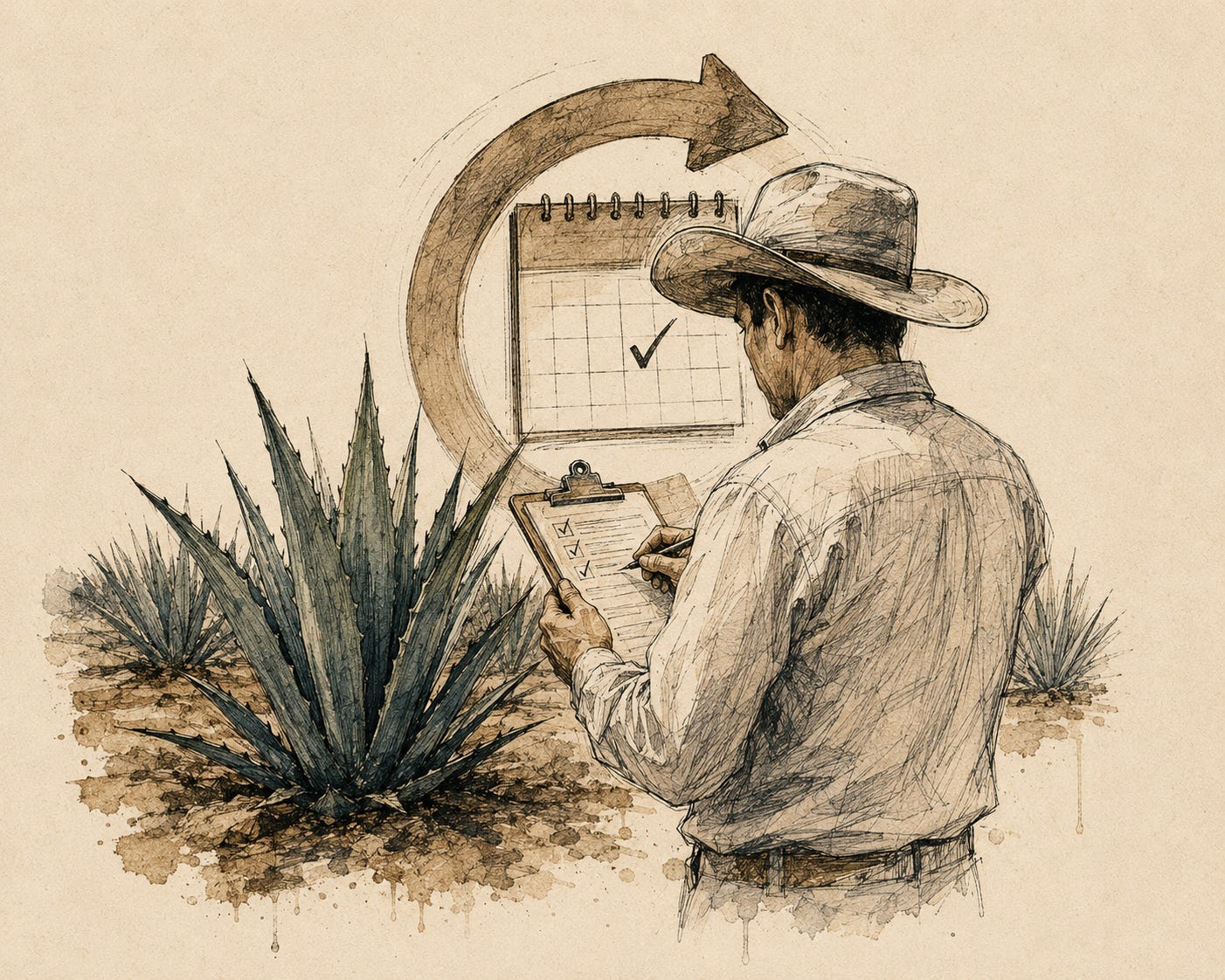
Before tequila becomes a spirit, it is a legal territory
At the foundation of tequila sits the DO — Denomination of Origin, held by the Mexican government. NOM-006 exists directly in relation to that legal protection.
Under NOM-006, tequila must be made from Agave tequilana weber blue variety, grown inside the territory protected under the Declaration.
That territory includes:
Jalisco
Guanajuato
Michoacán
Nayarit
Tamaulipas
A total of 181 municipalities within these states.
The law decides where tequila can begin. That is the first control point.
The CRT is where the regulation becomes real
One of the strongest things I understood after visiting the CRT was simple:
A regulation matters because somebody has to verify it.
The CRT (Consejo Regulador del Tequila) operates as the Conformity Assessment Agency referenced in NOM-006. The standard itself defines the Compliance or Conformity Assessment Agency as the Regulatory Council or accredited body responsible for verifying compliance.
That means tequila regulation is built as a chain of checkpoints.
Each one exists because the next one can be measured, compared, or verified against it.
That is what makes the system more difficult to fake, not infallible, but more difficult to fake.
Field registration
The first checkpoint starts years before tequila exists.
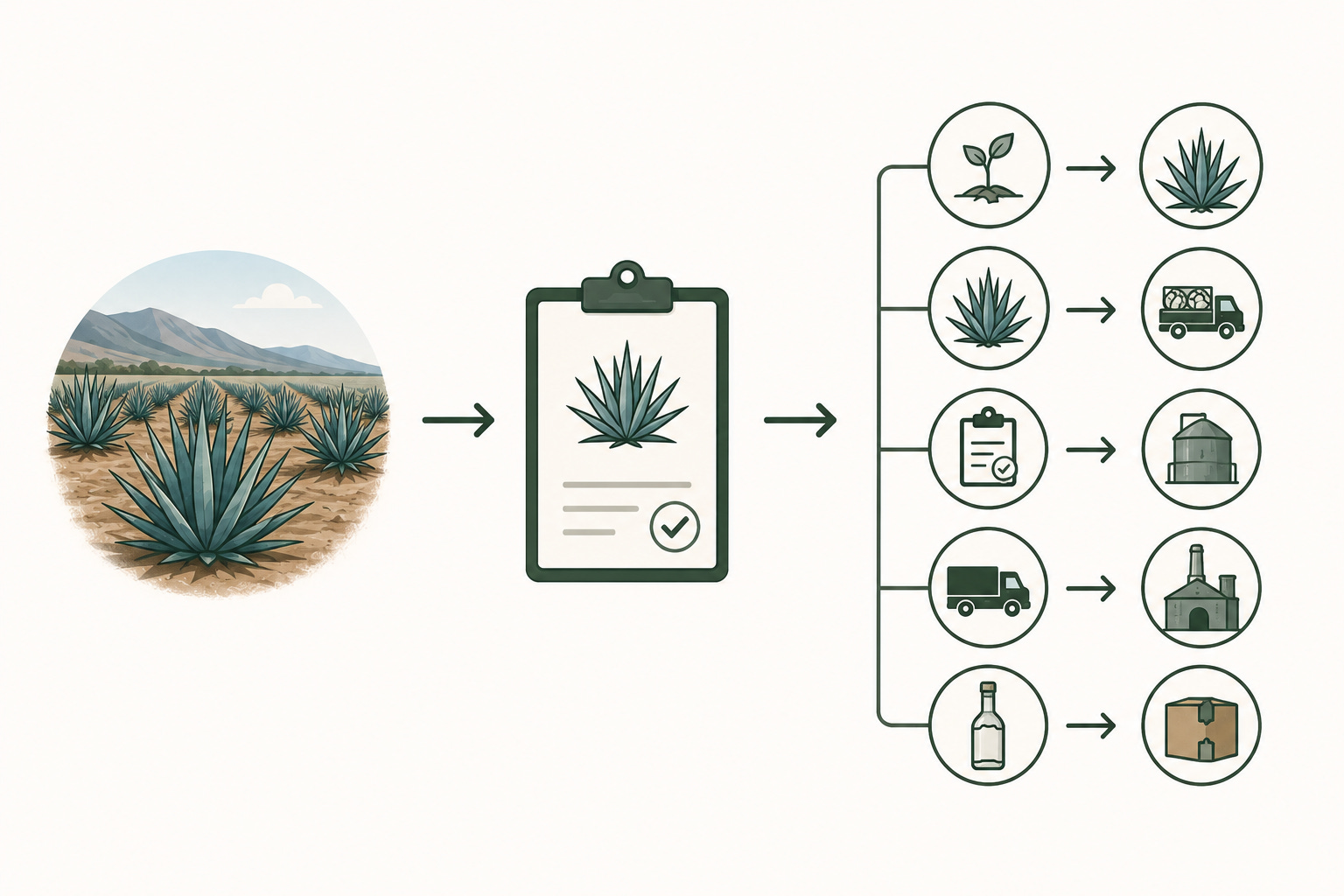
A Blue Weber agave field must be registered in the Plantation Property Registry, established by the Conformity Assessment Agency.
Why is that important? - Because once a field is legally registered, it creates a fixed agricultural record.
Later, authorities can compare:
what was planted
what was harvested
what was committed to tequila production
what was transferred
what eventually entered a distillery
Annual ratification
The owner or title holder must annually update or ratify the registration during the first six months of each calendar year.
This matters because agave is agricultural inventory. It changes.
Plants grow, fields are harvested, agave is sold.
Agave is committed to producers.
Some may be lost or damaged.
So annual ratification allows the agency to compare the original declared field against what physically continues into the tequila chain.
Without that, the registry would quickly lose value.
Documentary records
Once agave enters production, documentation becomes the backbone of control.
The producer must maintain records covering:
agave purchases
other sugar purchases
raw material input and output
inventories
product movement
ageing stock
bottling stock
Why?
Because each record becomes another point of comparison.
Authorities can cross-check:
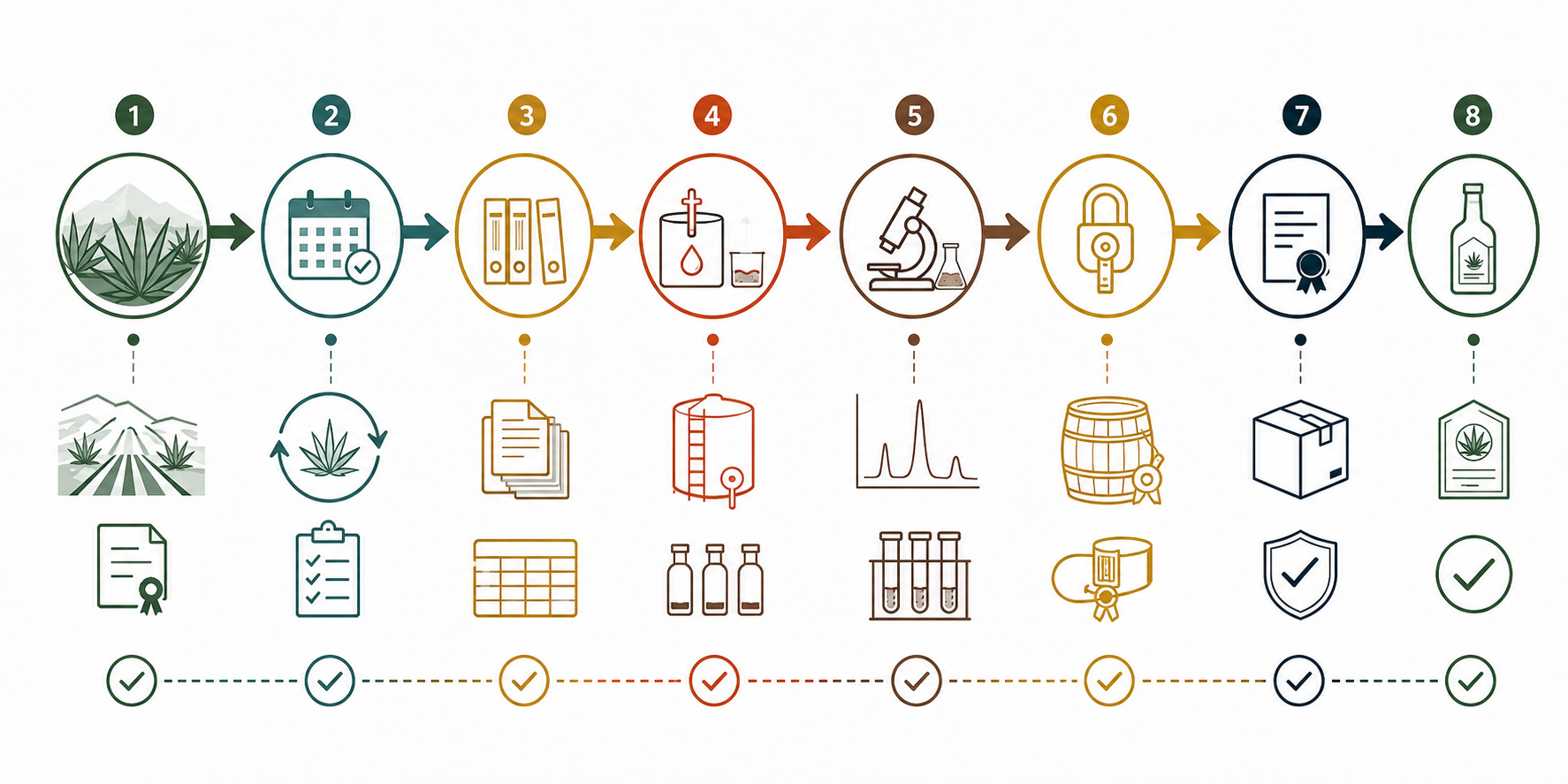
registered agave → purchased agave → sugars used → tequila produced → stock aged → stock bottled → stock released.
If the numbers fail to align, the chain breaks.
That is where documentation becomes verification.
Sampling
Paperwork cannot prove chemical conformity.
So the liquid itself is sampled.
That matters because authorities are not only checking declarations.
They are checking the physical batch.
For bulk tequila, samples can be taken from homogenized liquid or from different tank levels to make sure the batch is properly represented.
So sampling becomes the first physical checkpoint after documentation.
Lab analysis
Then the batch moves into chemical verification.
This is critical.
Because the system is not only asking:
Was tequila declared?
It is asking:
Does the liquid chemically match legal tequila specifications?
That is why the lab checks alcohol, sugars, volatile compounds, methanol, metals, and other analytical markers referenced in NOM-006.
So documentation proves declared identity.
The lab helps verify chemical identity.
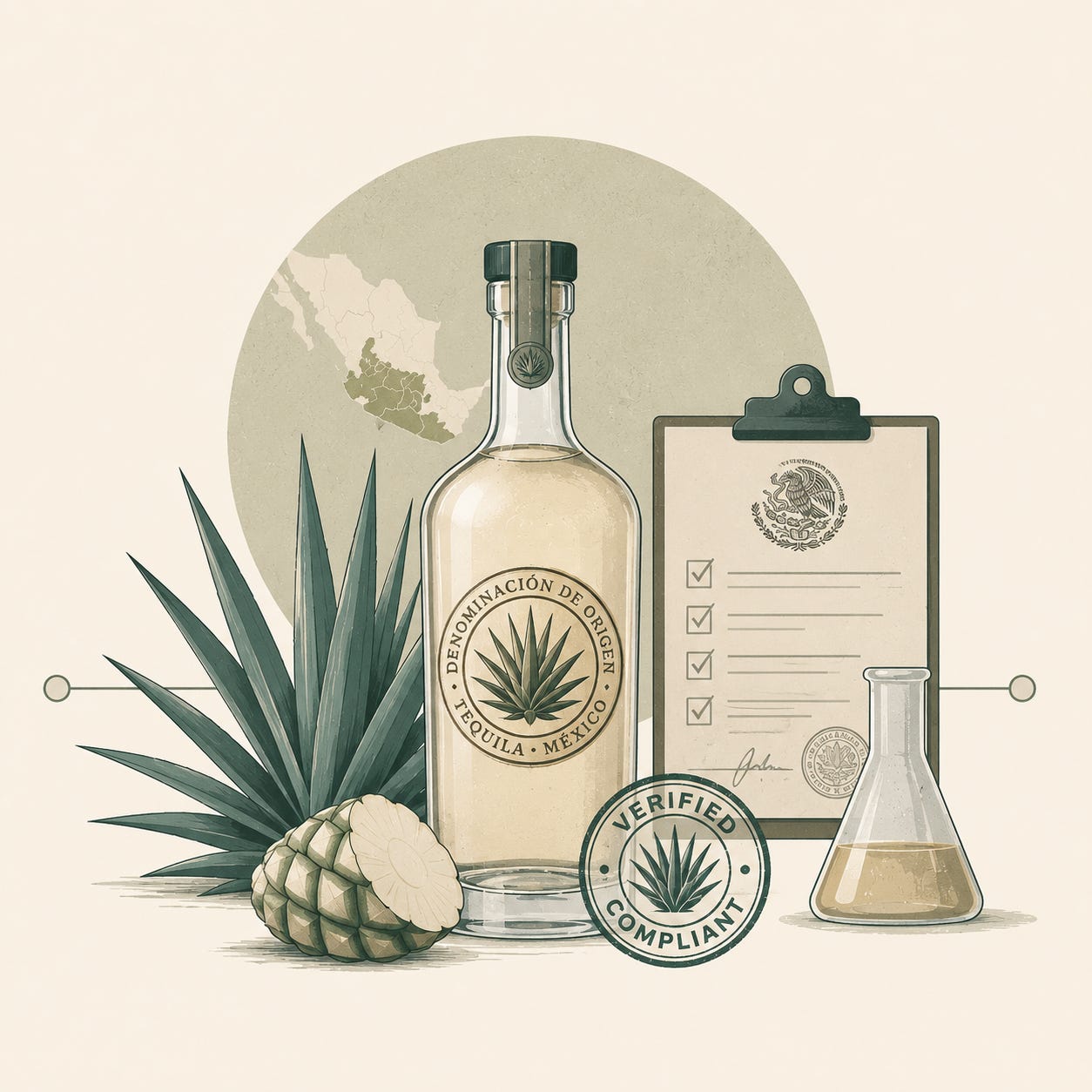
Seals
Then physical integrity must be protected.
That is where sealing becomes important.
Samples are labelled, signed and sealed.
Containers used in ageing and verification can also be sealed.
Why?
Because once a batch or container is sealed, it becomes much harder to tamper with, replace, or alter without breaking traceability.
So seals protect continuity between sampled liquid, stored liquid, aged liquid, and certified liquid.
Certification
Then the batch moves through formal compliance.
This is where the product is no longer just being produced.
It is being legally validated.
Documents, physical batch identity, analysis, and conformity all begin to support certification.
That means tequila enters the market through documented control, not only through production.
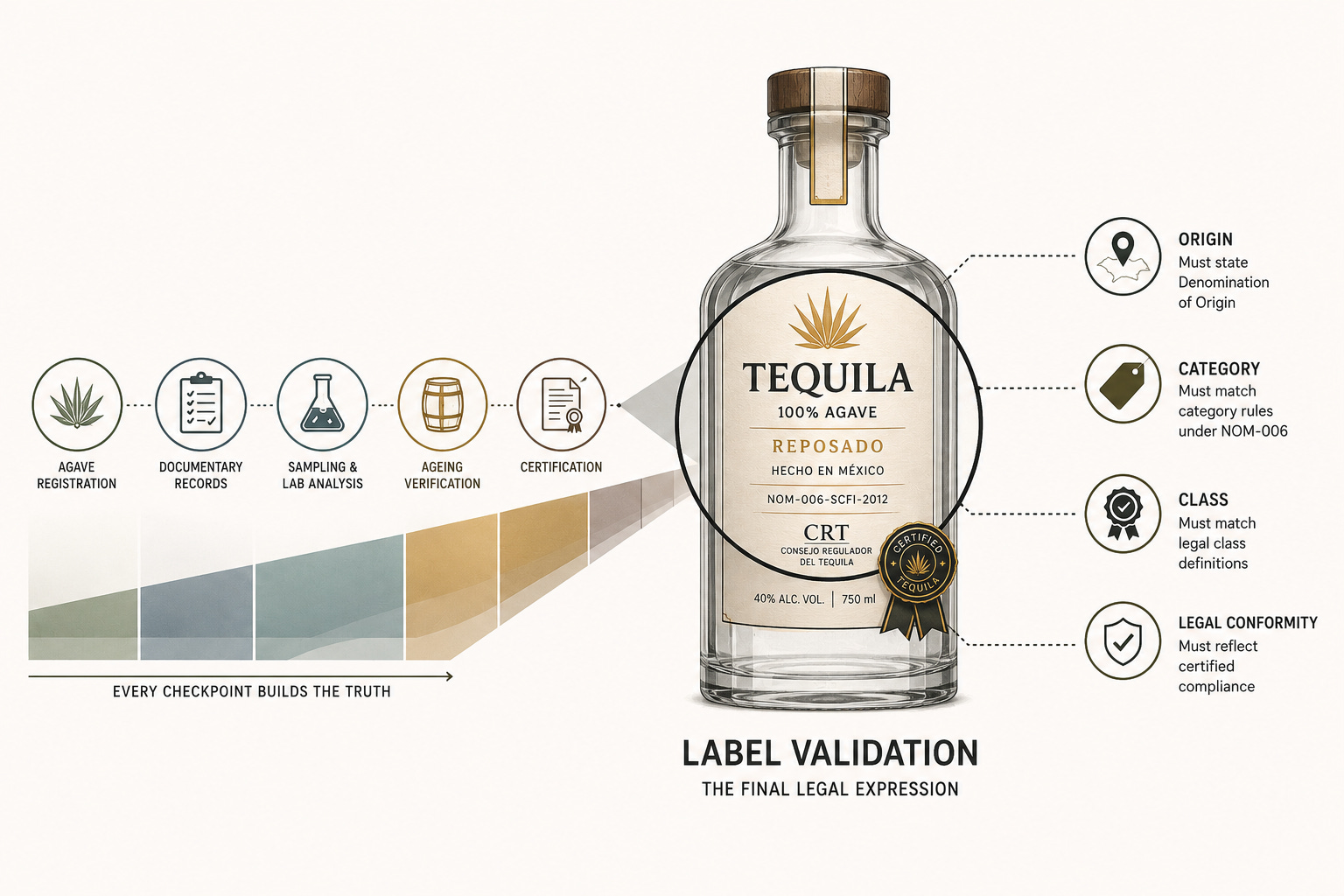
Label validation
Then finally, the label.
This is one of the strongest final checkpoints.
Because the label becomes legal identity.
At that point, what is written on the bottle must match:
origin
category
class
legal conformity
So the label is not simply communication.
It is the final legal expression of everything checked before it.
Each checkpoint exists because the next one can be verified against the previous one.
That is what makes the system difficult to fake.
Traceability
One of the strongest parts of NOM-006 is that control starts in the agave field.
For agave to legally enter tequila production, it must be Blue Weber agave, grown inside the protected territory, and registered in the Plantation Property Registry.
Then comes one of the strictest legal deadlines.
The field must be registered within the first year of planting, at the latest.
That matters because traceability starts before harvest.
Then the owner or title holder must annually update or ratify the registration.
That allows later comparison between:
registered agave → committed agave → harvested agave → agave entering production.
So the registry becomes more than administration.
It becomes traceability.

Once production starts, tequila becomes a documentary chain
Once agave enters production, the liquid is only one part of the system.
The paperwork becomes just as important.
This is where NOM-006 becomes highly practical.
The Authorized Producer must maintain updated records that include:
invoices confirming purchase of agave
invoices confirming purchase of other sugars
raw material input and output
movement of finished product
raw material inventories
finished tequila inventories
product allocated to ageing
product allocated to bottling
At first, this may look like administrative control.
But this is actually one of the strongest verification tools in the system.
Because these records allow authorities to reconstruct the production chain.
They can compare:
Raw material intake
How much agave entered?
If a producer declares output that does not reasonably align with raw material records, that creates an inconsistency.
Sugar use
How much additional sugar entered?
This matters because category compliance can depend on formulation rules under NOM-006.
So sugar movement becomes relevant beyond inventory.
Production output
How much tequila was produced?
Now authorities can compare declared output against earlier inputs.
Agave.
Sugar.
Batch identity.
Production records.
The numbers should make sense.
Ageing allocation
How much liquid was allocated to ageing?
This matters because later age claims must connect back to documentary evidence.
A Reposado or Añejo claim should connect to actual stored stock.
Bottling allocation
How much product moved into bottling?
That creates another checkpoint.
A producer cannot simply claim bottled stock without corresponding movement.
Finished product movement
How much product moved out?
At this stage, authorities can compare:
produced → aged → bottled → released.
So market movement also becomes traceable.
That is why these records matter.
Because by cross-checking them, authorities can identify inconsistencies in declared production, category, ageing, movement, or inventory.
Then the facility itself becomes controlled.
NOM-006 states that at no time may any product that does not contain tequila be distilled or produced in the Authorized Producer’s tequila facility.
That is a strong legal boundary.
Because integrity is also protected inside the distillery.
Then NOM-006 refers to continuous inspections by the Conformity Assessment Agency.
Because verification is designed to follow tequila while it is being produced, aged, moved, and bottled.
So the control system is not built only around the final bottle.
It follows the process itself.
The lab: how authorities verify the liquid
This is where tequila becomes highly technical.
A batch is not simply trusted.
It is sampled.
NOM defines a Lot or Batch as the quantity of product bottled during a single period of time to ensure identification.
That matters because the system is testing traceable lots.
For bulk tequila, samples are taken from homogenized tequila or from lower, middle and upper tank levels.
The minimum sample is 3 liters.
Then it is split into three 1-liter portions.
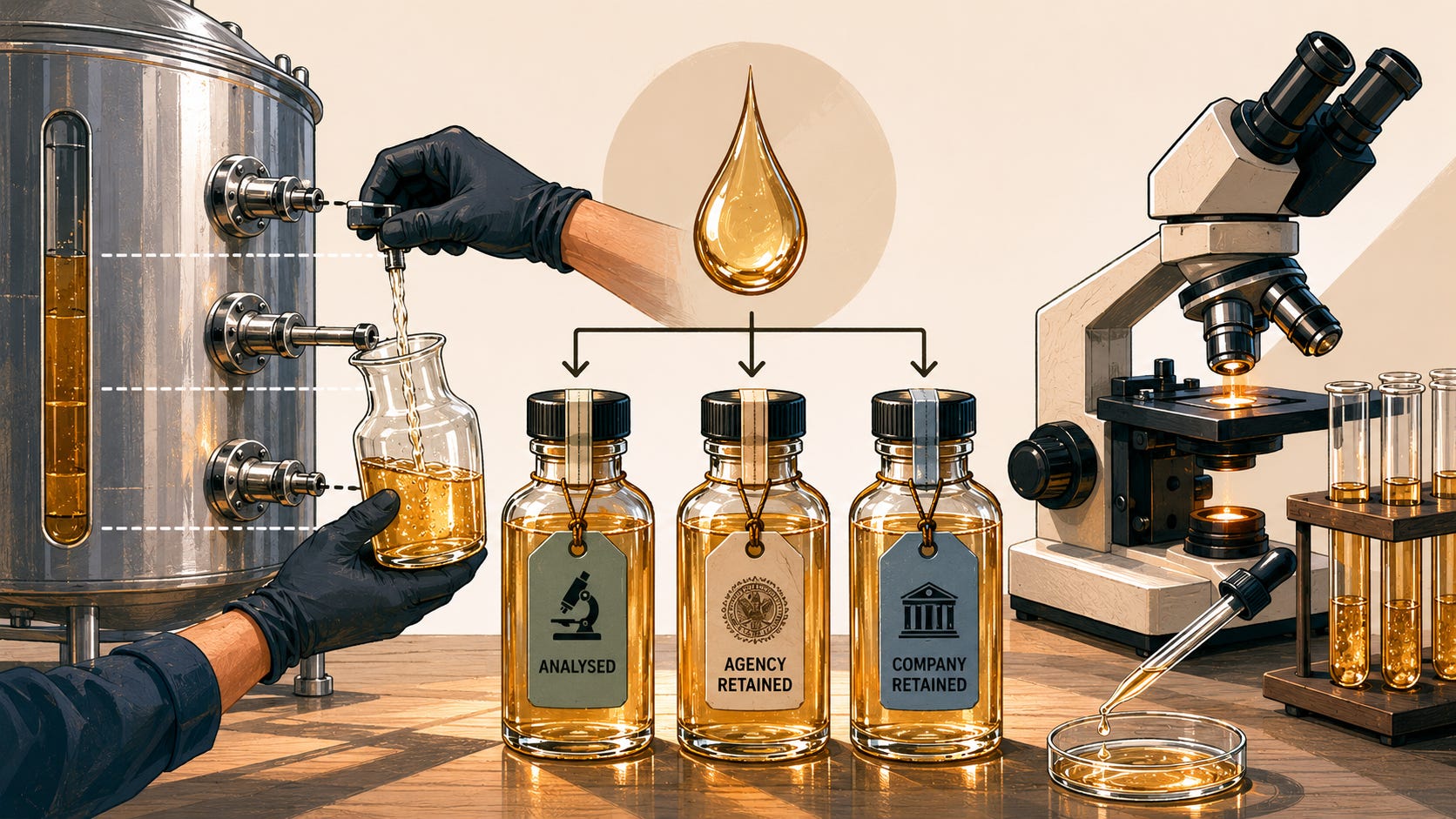
Why split it?
Evidence control.
One sample is analysed
One stays with the agency
One stays with the company
If something is challenged later, retained samples exist.
Then they are labelled, signed and sealed.
Barrels and smaller containers can also be selected randomly.
Then the lab becomes central.
NOM-006 links tequila verification to official Mexican testing methods.
That includes:
Alcohol content
To confirm the batch matches legal alcohol specification.
Direct reducing sugars and total sugars
To help verify composition and category compliance.
Esters, aldehydes, methanol and higher alcohols
To verify chemical conformity and safety.
Methanol matters because it is toxic and must remain within legal specification.
Metals
Including:
copper
lead
arsenic
zinc
iron
mercury
cadmium
calcium
These matter because contamination and unsafe levels must be controlled.
Furfural
Also measured under referenced methods.
So the lab is answering a bigger question:
Is this chemically compliant tequila?
Ageing, export certification, and why the label has to tell the truth
Tequila does not stop being regulated once it leaves fermentation or distillation.
In many ways, some of the most practical controls happen later.
Because by this point, tequila is no longer just a liquid in production.
It is becoming a commercial product.
And that means the category now has to prove that what is being sold matches what is being claimed.
That applies to age claims.
It applies to category claims.
It applies to export.
And it applies to the final label.
Ageing is not simply a claim
Take Reposado as an example.
A producer cannot simply age tequila and decide to call it Reposado because it “looks right” or because the label says so.
The category has legal definitions.
Under NOM-006:
Reposado must age for a minimum of 2 months
Añejo must age for a minimum of 1 year
Extra Añejo must age for a minimum of 3 years
For Añejo and Extra Añejo, there is another legal limit.
The spirit must age in containers with a maximum capacity of 600 litres.
These are not stylistic descriptors.
They are legal categories.
That means if a bottle says Reposado or Añejo, that claim must connect back to verifiable ageing records.
So how do authorities verify that?
How ageing is physically verified
The system does not rely on the label.
It relies on traceability.
CRT verification materials show that ageing control includes:
evidence of ageing containers
numbered records showing liquid entering and leaving those containers
sealed containers during ageing
seals placed and removed by the Conformity Assessment Agency
Why does this matter?
Because age claims need documentary and physical continuity.
Authorities can see:
how much liquid entered ageing → where it was stored → how long it remained there → how much liquid later exited that ageing system.
So a Reposado or Añejo claim is not simply commercial language.
It becomes something that can be traced through records, containers, and seals.
That is a very different level of control than simply trusting what is written on a bottle.
Classification itself is legal
NOM-006 legally defines tequila classes:
Blanco / Plata
Joven / Oro
Reposado
Añejo
Extra Añejo
That matters because these are not marketing terms invented by producers.
They are legal classifications with regulatory definitions.
So by the time a bottle reaches market, its declared class must match what the production and ageing records support.
Again, this is where paperwork, physical verification, and label claims start to connect.
Export certification: tequila enters another control chain
This is another part of tequila regulation that often gets overlooked.
Many people assume that once tequila has been produced, bottled, and certified, it simply gets exported.
But CRT materials show that export itself becomes another regulatory checkpoint.
The tequila batch enters a structured export certification process:
application review → document verification → inspector assignment → batch verification → sample collection → sealing → technical report → certificate issuance → customs surrender for export release
At first glance, this may look like administrative procedure.
But each checkpoint protects the integrity of the next one.
And once you understand that, you start to see how tightly tequila is controlled all the way to market exit.
Application review
The process begins when the producer or exporter formally enters the batch into the export certification chain.
This is important because it creates an official regulatory starting point.
At this stage, the batch is no longer simply stock sitting in a warehouse.
It becomes part of a documented export verification process.
That means traceability starts before physical release.
Document verification
Then the paperwork is checked.
This is one of the strongest first control layers.
Authorities review whether the documentary identity of the batch aligns with what is being submitted for export.
That includes checking:
production records
batch identity
declared category
declared class
origin
supporting conformity documentation
Why is this important?
Because before anyone touches the liquid, authorities need to confirm that the legal identity of the batch makes sense on paper.
If the documentary chain does not align here, the process already has a problem.
So this checkpoint protects legal consistency before physical verification even begins.
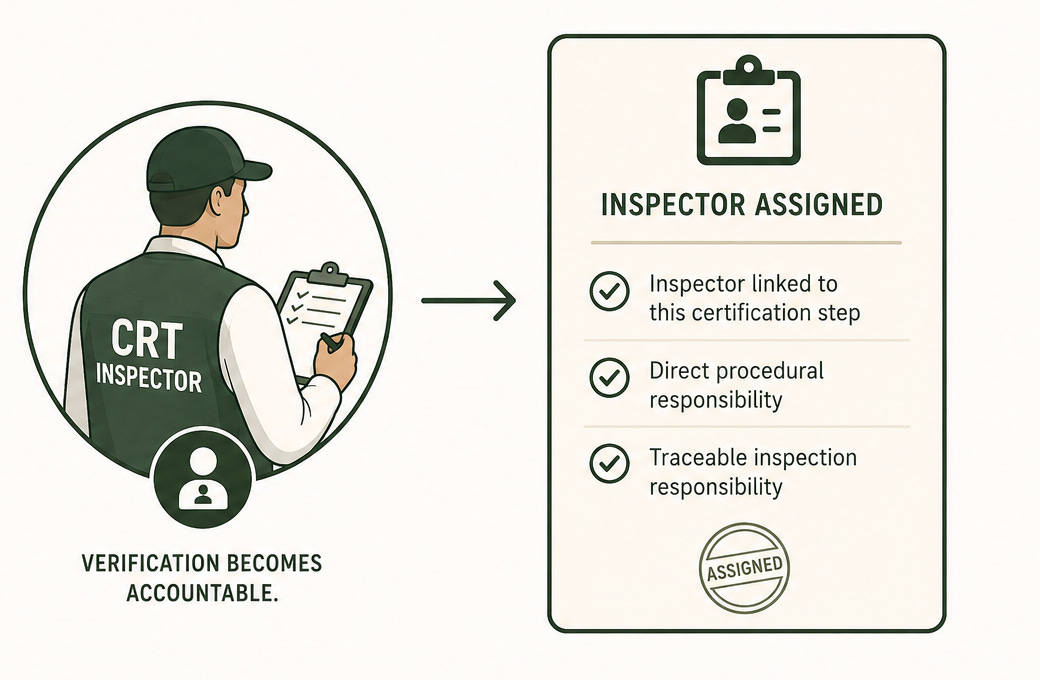
Inspector assignment
Then a specific inspector is assigned.
This sounds simple, but it matters.
Because now verification becomes accountable.
A real inspector becomes linked to that certification step.
That creates direct procedural responsibility inside the chain.
So this is not just “someone checks it.”
It becomes a traceable inspection responsibility.
Batch verification
Then the physical batch itself is checked.
This is where paperwork meets reality.
Authorities verify that the physical tequila being presented matches the batch described in the documentation.
That includes checking:
lot or batch identity
declared quantity
traceable product identity
alignment with submitted records
Why is this important?
Because the system is not trusting paperwork alone.
It is verifying that the declared batch and the physical batch are the same thing.
That becomes a major anti-substitution checkpoint.
Sample collection
Then the liquid itself is sampled.
Because paperwork cannot prove chemical conformity.
The batch must physically enter analytical control.
This is where authorities are asking:
Does this liquid actually match what this batch claims to be?
That supports:
chemical verification
category compliance
batch integrity
So the liquid itself becomes evidence.
Sealing
After sampling, containers are sealed.
This is one of the strongest physical control points in the export chain.
Why?
Because once the batch has been sampled, authorities need to preserve continuity between:
sampled liquid → stored batch → certified batch → exported batch
Without sealing, a sampled batch could theoretically be altered, replaced, or interfered with before export release.
Sealing protects that continuity.
It ensures that the batch being exported remains tied to the batch that was actually inspected and sampled.
That is a very strong integrity checkpoint.
Technical report
Then a technical report is issued.
This is where verification becomes documented evidence.
The report records that the batch has passed through inspection, sampling, and conformity review.
Why is this important?
Because the batch does not move forward based on verbal approval.
It moves forward based on technical evidence.
That makes the chain auditable.
Certificate issuance
Only after that can certification be issued.
At this point, certification is not simply permission to export.
It is confirmation that the batch has passed through the regulatory checkpoints required by the system.
That means:
documents were checked
the batch was inspected
the liquid was sampled
the chain remained intact
So the certificate becomes evidence of regulatory conformity.
Customs surrender for export release
Then the certification chain follows tequila all the way to export release.
The certificate is surrendered to customs as part of final export control.
This matters because control does not stop when tequila leaves the distillery.
It follows the batch until market exit.
So even at export, traceability is still active.
The label
At that point, the bottle becomes more than packaging.
Because everything before it now has to match what is written on it.
That includes:
origin
category
class
legal conformity
That is why the label matters so much.
Because by the time tequila reaches that final bottle, it has already moved through field registration, documentary traceability, production records, sampling, lab analysis, ageing verification, certification, and export control.
So the label is not simply branding.
It becomes the final legal expression of everything that was checked before it.
Final Sip
Before visiting Mexico, I understood tequila through the lenses most of us usually do.
Raw material.
Production.
Distillation.
Ageing.
Flavour.
And all of that matters.
But after spending time at the CRT and seeing how the regulatory system actually works, I understood something much bigger.
Tequila is not only protected by tradition or production method.
It is protected by documentation.
What stood out most was how deeply control is built into the category itself.
Traceability begins in the agave field, years before harvest.
Production records are built so raw material, liquid, ageing stock, bottling stock, and market release can be cross-checked against each other.
Batches are physically sampled, sealed, and analysed in the lab.
Age claims can be verified through containers, movement records, and sealed ageing systems.
Export certification follows the batch beyond the distillery.
And by the time the bottle reaches the market, the label is no longer just packaging. It becomes a legal declaration of origin, category, class, and conformity.
Tequila is not only one of the most culturally important spirits categories in the world.
It is also one of the most documented, verified, and cross-checked.